
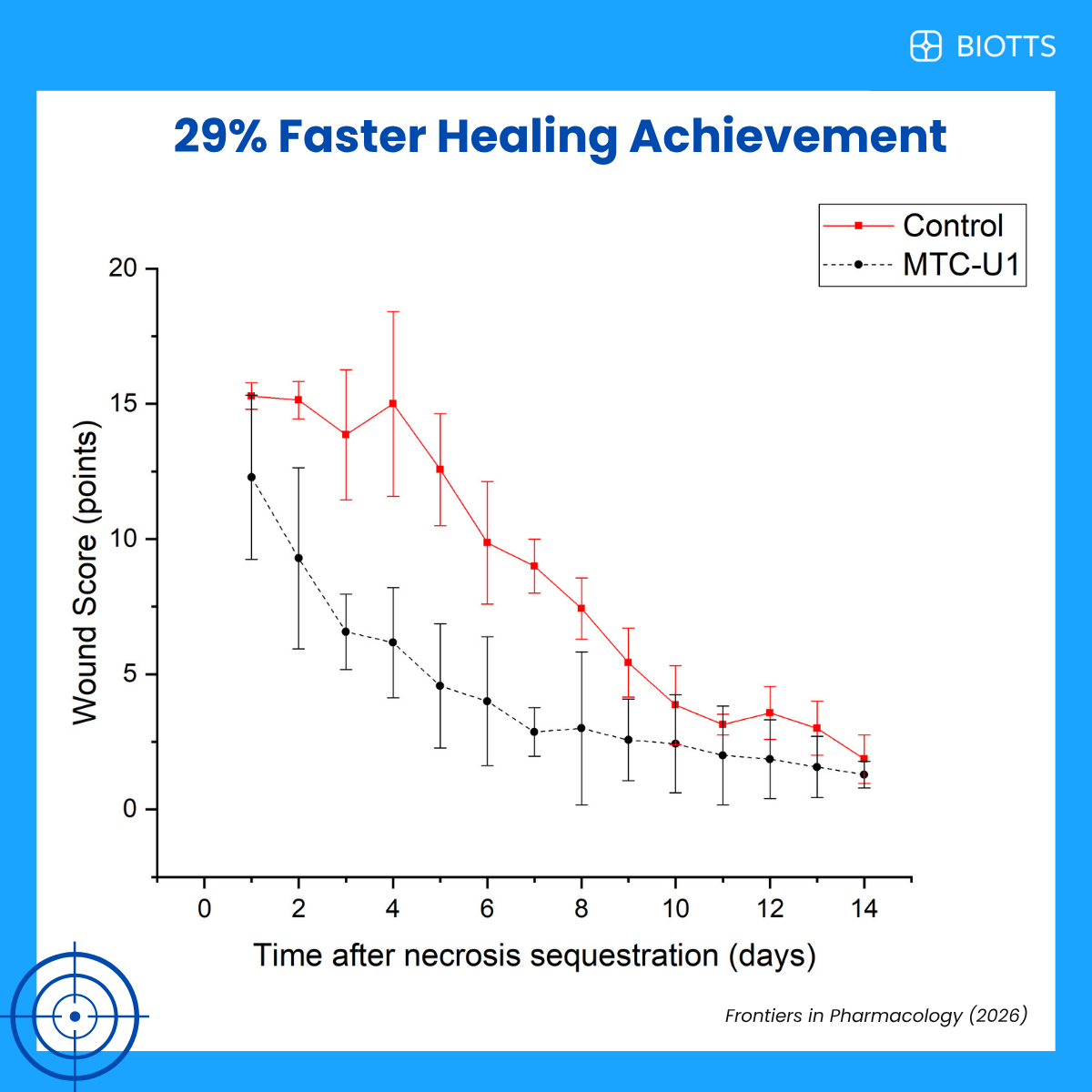
The controlled, randomized study demonstrates that a novel topical formulation (MTC-U1) powered by Biotts’ patented multifunctional carrier technology, significantly accelerates the healing of complex, infected chronic wounds, outperforming standard conventional antibiotic therapy (oxytetracycline).
Chronic wounds and deep bacterial biofilms represent a severe global clinical burden and a major area of unmet therapeutic need. Traditional topical vehicles often struggle to achieve deep tissue penetration or break through the protective matrix of a biofilm, while the escalating antimicrobial resistance (AMR) crisis severely limits antibiotic efficacy.
By integrating natural active compounds into the proprietary Biotts delivery platform, the R&D team successfully drove targeted penetration deep into affected tissues, delivering key statistical advantages over the current standard of care:
- 29% Faster Healing.
The formulation leveraging Biotts’ technology achieved complete wound closure and scab formation an average of 3.86 days faster than the antibiotic group (p = 0.023). - Rapid Local Action.
Statistically significant clinical improvements were visible by Day 2 of application (p < 0.01), corroborated by infrared thermography showing rapid reduction in local inflammation. - Systemic Resolution.
Hematological assessments confirmed systemic recovery, with neutrophil counts normalizing efficiently within the Biotts group (14.54 → 8.79 × 10⁹/L, p < 0.05) while remaining elevated in the antibiotic cohort. - Favorable Safety Profile.
The formulation demonstrated excellent local tolerance, recording an irritation index of less than 0.5.
These results provide strong validation for the commercial viability of the Biotts drug delivery platform. By demonstrating that the proprietary carrier can significantly enhance bioavailability and therapeutic outcomes where standard pharmaceutical vehicles fail, Biotts opens a clear clinical pathway for next-generation treatments targeting diabetic foot ulcers, severe burns, and hard-to-heal surgical wounds.
Read the full study here: https://www.frontiersin.org/journals/pharmacology/articles/10.3389/fphar.2026.1798208/full